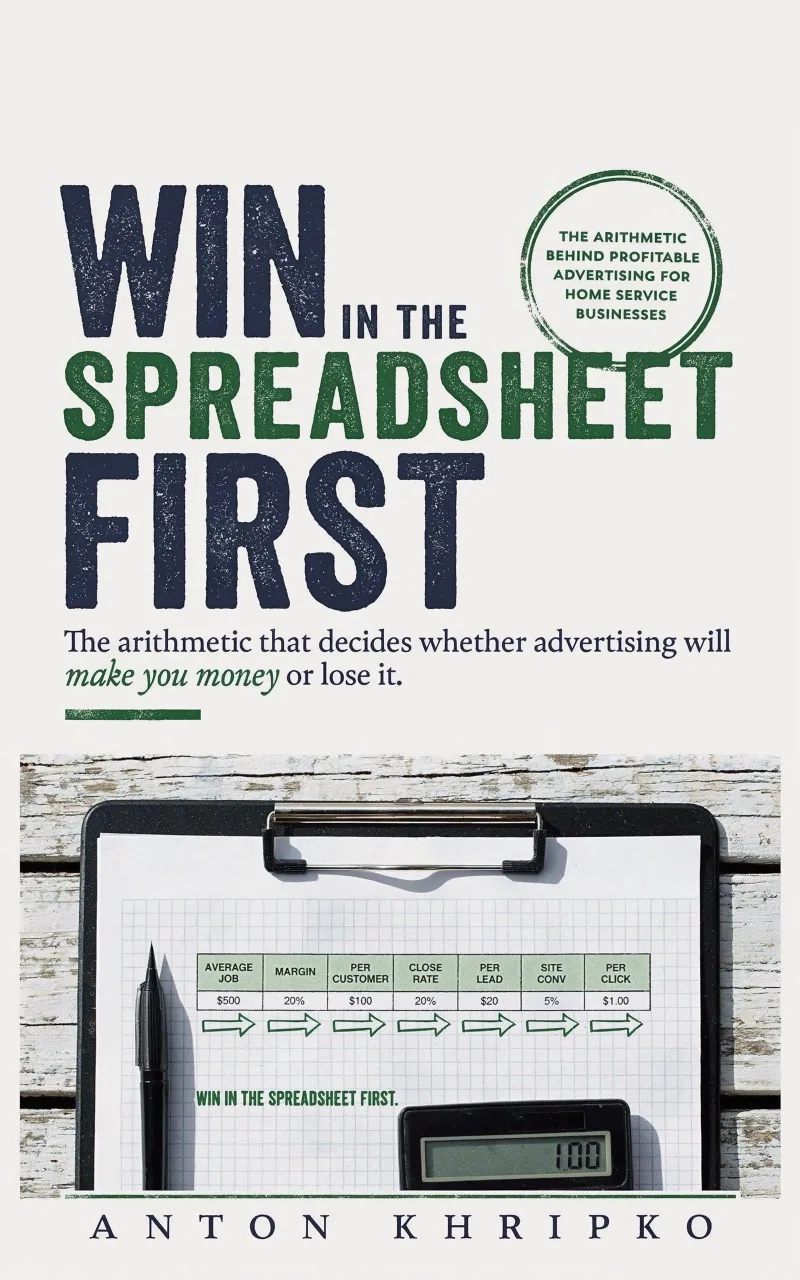
The seven numbers from the book
Three things live on this page: the spreadsheet that does the arithmetic, the free public calculation, and the place to send your own seven numbers.
The spreadsheet
Seven numbers in. Three numbers out: the most you can pay for a customer, for a lead, and for a click. Run it once per service line — a kitchen and a deck are not the same business.
Free, and there is nothing to sign up for.
Enter your seven numbers
These are break-even ceilings: at these numbers you make nothing. What you actually pay has to sit below them, and the gap is your profit.
What this calculates
Profit per customer = average job × margin × jobs over the relationship, plus whatever else the customer brings. Most you can pay for a lead = profit per customer × close rate. Most you can pay for a click = that × website conversion. The book never went further than this.
The free public calculation
You bring your numbers. We run the calculation together. The result gets published — anonymized. That is the price, and it is the whole price.
- What gets published: your trade, roughly how big you are, the seven numbers, and what the arithmetic said.
- What never gets published: your name, your company, your city, or anything that could be reversed into an identifiable business. You can withdraw before it goes up.
- What usually happens: four out of five businesses that do this hear not yet — their maximum sits below what their market charges, and the fix is in the business rather than in the advertising. That is the most likely outcome and the cheapest one.
Would rather keep it private? Then it is ordinary paid work: nothing published, nothing shared. Get in touch.
Send your seven numbers
There is no public dataset of unit economics for home services. The numbers exist — you have them, or you can produce them in an evening — and they die inside individual spreadsheets, one business at a time.
Send yours and I will publish what they add up to: ranges by trade, by size, by market. Where the spread is wide you will see the spread, not an average.
Published: the aggregate only. Never published: you, your company, or your numbers as you sent them.
What you get: the aggregate, when it goes up. Nothing else — this is not a mailing list. The first aggregate publishes once a hundred businesses have sent their numbers. No date attached, deliberately: a deadline would only tempt me to publish thin data, and thin data is exactly the thing this is meant to replace.
If you do not have the book yet
187 pages. Paperback $19.99, Kindle $9.99. The same seven-number calculation the spreadsheet above runs, plus ten real businesses with the numbers before and after — two of which never ran a campaign at all.
Neither the calculator nor the public calculation requires the book: the calculator is free, and the public calculation costs what it says above — publication.