
For residential HVAC, plumbing, and roofing companies, the Google Local 3-Pack is often the primary driver of organic telephone inquiries.
When a profile experiences a sudden drop in map visibility, inbound call volume can decline rapidly.
However, diagnosing local ranking fluctuations requires understanding how Google’s local algorithm functions.
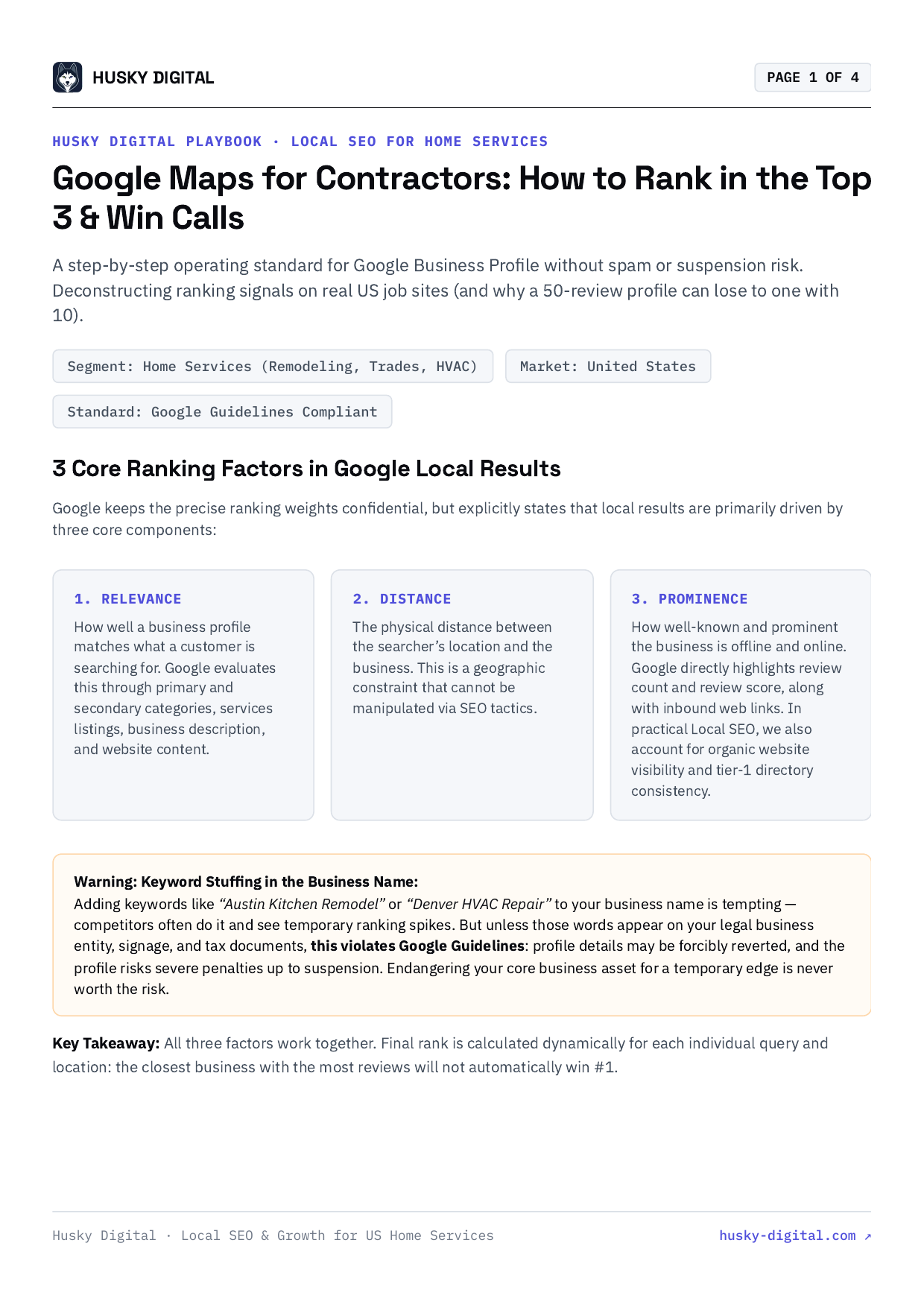
Google does not operate on a fixed citywide ranking; local rankings reflect a dynamic balance between three core pillars: Relevance, Distance, and Prominence.
Here is a structured diagnostic framework to identify why your local profile may have lost visibility and how to systematically address it.
1. Understanding Proximity & Local Grid Patterns
Before making drastic profile changes, recognize that local search results are location-dependent.
If you search for your trade from your shop desk, you may see your business in position #1. If a customer searches from a neighboring suburb 6 miles away, your listing may rank lower simply due to physical distance from the searcher.
When contractors observe visibility drops across rank tracking tools (like local geo-grid scanners), the pattern often reflects:
- Increased competitor density in outlying areas.
- An algorithmic adjustment to how Google weights distance versus prominence in that trade.
- A change in your profile’s core relevance signals.
2. Common Causes of Local Visibility Shifts
When a profile experiences a sudden decline across its normal service area, review these frequent catalysts:
1. Inadvertent Business Name Changes or Keyword Trimming
Google’s guidelines require that your Business Name reflects your real-world, legally registered business name without added promotional keywords or city tags.
If an account administrator added descriptive keywords to the title and Google (or a user edit) reverted the name back to the official legal title, the listing may experience an immediate ranking readjustment.
2. Primary Category Adjustments
Your Primary Category is one of the heaviest algorithmic relevance signals.
- If a primary category is accidentally changed (for example, switching from
HVAC Contractorto a niche secondary category likeAir Duct Cleaning Service), visibility for primary high-volume terms will drop sharply. - Ensure your primary category precisely reflects your core revenue-driving trade.
3. Review Velocity and Recency Shifts
Prominence includes review volume, rating quality, and review recency. If competing businesses maintain steady review velocity (consistently earning fresh, authentic customer reviews weekly) while your profile remains inactive for several months, competitors may gradually overtake your positions.
4. Technical Entity & Website Sync Issues
Your Google Business Profile is closely tied to your website’s landing page URL.
If your website recently underwent redesign changes that altered address information, removed localized LocalBusiness schema markup, or introduced broken links, Google’s systems may recalibrate entity confidence.
3. Systematic Diagnostic & Recovery Protocol
[Phase 1: Profile Audit]
├── Verify Business Name strictly matches your legal registration / signage.
├── Confirm Primary Category is set to your primary service line.
└── Ensure Secondary Categories are relevant and not excessively diluted.

[Phase 2: Website & Entity Alignment]
├── Check that the landing page URL on GBP is functional and mobile-optimized.
├── Verify that Name, Address, and Phone (NAP) in the website footer match GBP.
└── Ensure structured LocalBusiness JSON-LD schema is active and error-free.

[Phase 3: Ongoing Prominence Building]
├── Encourage regular, honest customer feedback through routine post-job outreach.
├── Upload authentic, recent job photos regularly via the GBP dashboard.
└── Maintain accurate, consistent business hours and contact details.
Test your company’s customer acquisition economics below:
Your Target Cost Per Click
Your bid ceiling comes from your unit economics, not Google's auction. Enter your baseline metrics to calculate your target thresholds.
Average customer invoice for the job type. Total job revenue ÷ completed jobs.
Gross profit margin after direct technician labor and materials. Typically 40–60%.
Share of gross contribution allocated to customer acquisition. Typically 25–35%.
Share of qualified leads that close into paying customers. Typically 30–60%.
Share of site visitors that call or submit an inquiry. Typically 5–15%.
$2,500 × 50% (job value × gross margin)
$1,250 × 30% (gross profit × marketing allocation %)
$375 × 40% (Max CAC × close rate)
$150 × 10% (Max CPL × site conversion)
Target bid ceiling under these unit economics assumptions for first-job acquisition.
Run these numbers for your market
This is a unit economics planning model under stated first-job margin assumptions, not an auction guarantee. Real click cost depends on auction dynamics, ad relevance, and customer LTV.
Frequently asked questions
- What are the primary factors Google uses to rank local businesses?
- According to Google's official local search documentation, local rankings are based on three primary pillars: Relevance (how well your business matches the searcher's query), Distance (how close your location or verified service area is to the searcher), and Prominence (how established and well-reviewed your business is online).
- Why do Google Maps rankings appear different depending on where you search?
- Google local search is dynamic based on user location. A searcher standing two blocks from your office will see a different set of 3-Pack results than a searcher five miles away, because Distance (proximity) is continuously factored into the result set.
- How long does it typically take to recover from an algorithmic local visibility drop?
- There is no guaranteed recovery timeline. If the drop was caused by inadvertent profile edits or category changes, restoring proper settings often takes 1 to 3 weeks for Google's systems to re-evaluate. If a formal profile suspension occurred, the reinstatement review process typically takes several weeks.